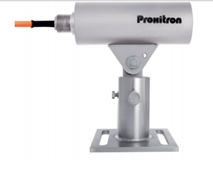
Compact IR thermal imaging camera was installed to provide a temperature map of the bottom shell. The cameral scans the full bottom of the shell giving options to define multiple areas /ROI to get 4-20mA output. Software automatically finds hot spots enable timely preventative maintenance.

Home  Case Studies Special looper encoders withstand the most extreme operating conditions in hot roll stands

Transfer Car Detection using Proximity

Home    Case Studies    Pilger mill in tube rolling mills – hot and cold pipe detection

Pilger mill in tube rolling mills - hot and cold pipe detection

Process reliability with proximity

  • Safe supply and discharge of gas
  • Assurance of correct electrode position
Picture2

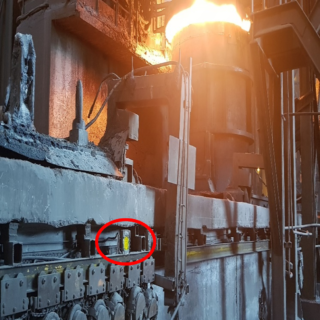
Proximity installed in steel melt shop

Challenges

  • Continuous and reliable management of high temperature is required.
  • Earlier proximity was sensitive to magnetic field and failure in high temperature.

Solution

  • Color detecting sensors support positioning of electrodes in electric arc furnace.
  • Proximity is insensitive to magnetic fields.

Specifications

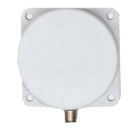
  • Sn: 140 mm
  • IP 67
  • Temp: -25 to +70 °C
  • Supply voltage: 20-260 V AC/DC
  • Cable length: 2,5,10,15,20 m
  • Cable MOC: Silicone cable
  • No. of wires: 3-wire
  • Housing (Ǿ): 110x110x43
  • Cable conduit protection available (Pg X)

Case Study Number

  • TP3

Challenge

  • The increasing flexibility of production lines requires a high adaptability of sensors. Continually changing object geometries, different temperatures and very high radiation or surrounding temperatures are no rarity.
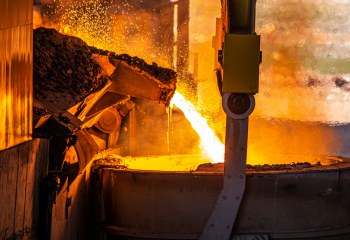
  • In a pilger mill those rough conditions can be found, among others in the production of seemless steel pipes. The raw steel blocks, each weighing a few tons are heated up first in a round oven at a temperature of 1300 °C.
  • After descaling of the surface, the steel block is prepunched in a hole press with a strength from a converted 2000 t. In the next sloping rolling mill the growing pipe rotates between two rollers that are positioned at an angle to each other. The punching is widened to the size of the mandrel diameter.

Previous solution / Competitor product

  • N/A

Solution

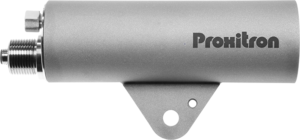
  • The sensor that was installed at this application is the HMD OKA 2038.38 G with tube OL 19.
  • The signal of the infrared sensors controls the movement of centering device and abutment. The point of view is restricted by the tube and prevents disturbances by steam in the cooling phase.
  • An optimum adaptation to the operating conditions is given due to the adjustable response temperature. The HMD with self-learning response temperature (Auto-Teach function) is suited to continually changing conditions.
  • The compact sensor with a stainless steel housing can withstand surrounding temperatures of up to 75° C. The use of a cooling jacket raises this up to 200° C.
  • Alternatively sensors with fibre optic cables are available which permit an application at ambient temperatures up to 600° C without cooling.

Customer Benefits

  • Maintenance-free
  • High temperature stability
  • Recognition of hot objects at big distances
  • Self adjustment with Auto-Teach or step switch for the response temperature

Product Part number

  • OKA 2038.38 G

Brand

  • Proxitron

Accessories

  • Piros swivel stand HM2
  • Tube OL 19
  • Pilot light unit (for alignment) DAK 308 + OL 26
  • Different cable lengths (e.g. 15 m)

Customer Testimonial

compared to previous solution or competition

Case Studies

Other applications in Steel Making

Sample case study title lorem ipsum here

Short description of the problem solved, maybe include the client name.

Sample case study title lorem ipsum here

Short description of the problem solved, maybe include the client name.

READ MORE

Sample case study title lorem ipsum here

Short description of the problem solved, maybe include the client name.

READ MORE
GET IN TOUCH